

Water knowledge
Still water: more than water without carbonation
Still water passes for the unassuming choice, yet among mineral waters it is the most demanding category. Without the sparkle of carbonation, nothing distracts from a water's character: mineralisation and origin come through in the taste, unadorned. That is also why fine dining so often reaches for the still bottle.
Updated August 2026 · 7 min read
In brief
- Without carbonation a water shows its character undisguised: its mineralisation and its origin.
- Neither still nor sparkling is healthier as such — both contribute equally to fluid intake.
- For coffee and tea the mineralisation matters; moderate, balanced values are considered a good base.
What is still water?
Still water is water that contains no carbonation, or only minimal amounts. The categories commonly found in shops (“still”, “medium” and “sparkling”) differ solely in their carbonation level; they say nothing about origin, purity or mineral content. A still mineral water must meet the same strict requirements as any other natural mineral water: it comes from an underground source protected from contamination, is bottled directly at the spring and is characterised by original purity and a consistent mineral composition. How the categories differ in legal terms is explained in our article on spring water and mineral water.
With still waters, the bottler simply refrains from adding carbonation. Some springs naturally carry a little carbonic acid; many, particularly in the Alps, are practically free of carbonation to begin with. “Still” is therefore not a processed state but often the most natural form in which a water emerges from the mountain.
Why is still water no less fresh?
When drinking, the impression of freshness comes largely from the carbonation: it stimulates the nerves in the mouth and adds a slightly acidic tingle on the tongue. This is a sensory effect and says nothing about the actual condition of the water. A still mineral water is bottled under the same hygienic conditions as a sparkling one and is just as fresh from the spring.
Those who find still water bland have usually grown accustomed to the distraction of the fizz. Without carbonation, the fine differences between waters emerge more clearly: a soft, mildly mineralised water tastes noticeably different from a richer one with a pronounced mineral note. Water sommeliers taste still waters for the same reason, since the character of a spring only shows once the fizz is out of the way.
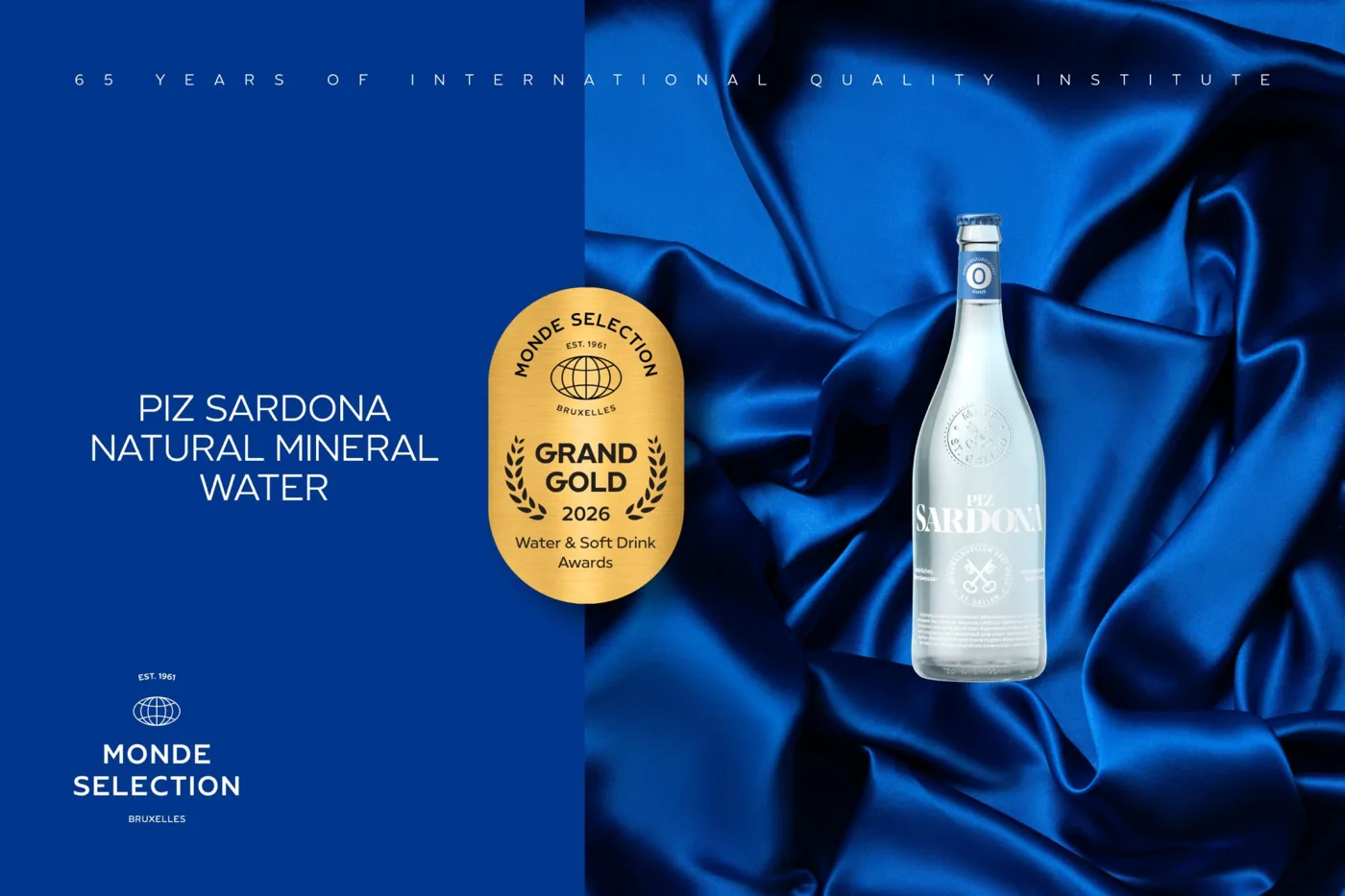
Incidentally, Piz Sardona No. 0 — the still water — received the Grand Gold Quality Award from the expert jury of Monde Selection in Brussels in 2026.
How do you recognise quality in still water?
Your most important tool is the label. Every natural mineral water declares its analytical values, and they read like a profile of the spring:
- Total mineralisation: it indicates how many dissolved minerals a litre contains. Lightly mineralised waters come across as delicate and soft, more highly mineralised ones as richer and more present.
- Calcium and magnesium: the two most abundant minerals in many waters. They also shape water hardness, as familiar from hard water.
- Sulphate and hydrogen carbonate: sulphate can contribute a subtly bitter note, while hydrogen carbonate has a balancing, mild effect on the taste.
- Sodium: at low concentrations it remains neutral in taste; salty notes only emerge at markedly higher levels. For anyone on a low-sodium diet, this is the single most important figure on the label.
Quality also shows in consistency: natural mineral water must remain constant in its composition, within the bounds of natural variation. Only a geologically stable spring can keep that promise. The pH value also appears on many labels: it describes whether a water is neutral, slightly acidic or alkaline, and it too influences the impression of taste.
Which still water pairs with food and wine?
In fine dining, still water is the first choice with food, for a simple reason: carbonation taxes the palate and heightens the perception of acidity, and its prickle can mask the delicate aromas of dishes and wine. A still water accompanies without competing. As a rule of thumb for pairing:

- Delicate dishes and finely structured wines: lightly mineralised, soft waters that hold back.
- Robust dishes, braises and mature cheese: richer waters with a noticeable mineral note.
- As a companion across an entire menu: a medium, balanced mineralisation that neither disappears nor dominates.
Piz Sardona, for example, occupies this balanced middle ground: a naturally alkaline still mineral water with a pH of 8.0 and a total mineralisation of 540 mg per litre – restrained enough to accompany finely structured wines, and present enough for heartier cooking. This balance is why it sees itself as a mineral water for gastronomy.

What myths surround still water?
- “Still just means flat”: wrong. Flat describes a carbonated water that has lost its sparkle. Still mineral water is bottled without carbonation from the very start; it cannot “go flat” because there is nothing to escape.
- “Carbonation disinfects the water”: carbonic acid can inhibit the growth of some microorganisms, but it is not a disinfectant. Still mineral water is subject to the same strict requirements for original purity and is tested regularly.
- “Still water contains fewer minerals”: the mineral content depends on the spring, not on the carbonation. There are highly mineralised still waters just as there are lightly mineralised sparkling ones.
- “Still water tastes of nothing”: quite the opposite. Without the fizz, differences in mineralisation and texture become all the more perceptible.
Mineral water is a foodstuff, not a remedy. Reputable producers promise no health effects. If you have health complaints or questions about your personal diet, consult a doctor or a qualified nutrition professional.
How do you store still water correctly?
Still water is best stored in a cool, dark place free of odours. Glass bottles protect the contents particularly reliably; PET is slightly permeable, which is why water in plastic bottles can pick up off-flavours from its surroundings over time, for instance when stored next to cleaning products in the cellar or garage.
The best-before date is not an expiry date: unopened and correctly stored, mineral water generally remains perfectly sound well beyond it. Once opened, keep it cool and drink it within a few days. Ideally, pour it into a glass instead of drinking straight from the bottle, so that fewer germs from the mouth find their way in.
And if you ever want to give a still water your full attention: the Castels spring in Mels is fed by water that seeps into the ground at over 2,000 m above sea level in the Sardona Alps, near the UNESCO World Heritage Tectonic Arena Sardona, and filters through layers of rock and stone for around 12 years before being tapped and bottled. You can read more on the page about our water.
Frequently asked questions
Is still water healthier than sparkling water?
Not as a general rule. The mineral content comes from the spring and has nothing to do with carbonation, and both variants contribute equally to hydration. Some people find carbonated water less agreeable (belching or a feeling of fullness, for instance), and that varies from person to person. If discomfort persists, it is best to have the cause clarified by a doctor.
Is still mineral water the same as tap water?
No. Natural mineral water comes from a protected underground source, is bottled at the spring and must be of original purity; only a few clearly defined treatment steps are permitted. Tap water is also strictly monitored, but it may be treated and, depending on the region, comes from various sources such as groundwater, lake water or spring water. Both are safe foodstuffs, but they follow different rules.
Is still water suitable for coffee and tea?
Yes. For hot drinks, still water is the obvious choice anyway, since carbonation escapes when heated. What matters is the mineralisation: very hard water can mask aromas and leave limescale in machines, while extremely soft water quickly makes coffee taste flat. In the coffee world, waters with a medium, balanced mineralisation are therefore considered a good basis.
Is still water the better choice for sport?
That is above all a question of comfort. Many people find it easier to drink larger quantities without carbonation, and there is no belching during exertion. For hydration, what counts first and foremost is drinking regularly and sufficiently throughout the day – whether still or sparkling remains a matter of taste.
Read next
Spring water or mineral water? The difference is defined by law
Spring water or mineral water? Learn how Swiss food law separates the two categories and how to recognise them on the label.
ReadDrinking hard water: safe – what hardness really means
Why hard water is safe to drink and what the Swiss °fH scale tells you about calcium and magnesium in your water.
ReadCan you drink distilled water?
Small amounts of distilled water are harmless and the burst-cell story is a myth. Why it still makes no sense as an everyday drink.
ReadPiz Sardona
Alkaline mineral water with a pH of 8.0 from the Castels spring in Mels — filtered through the rock of the Sardona Alps for twelve years.
Our water