

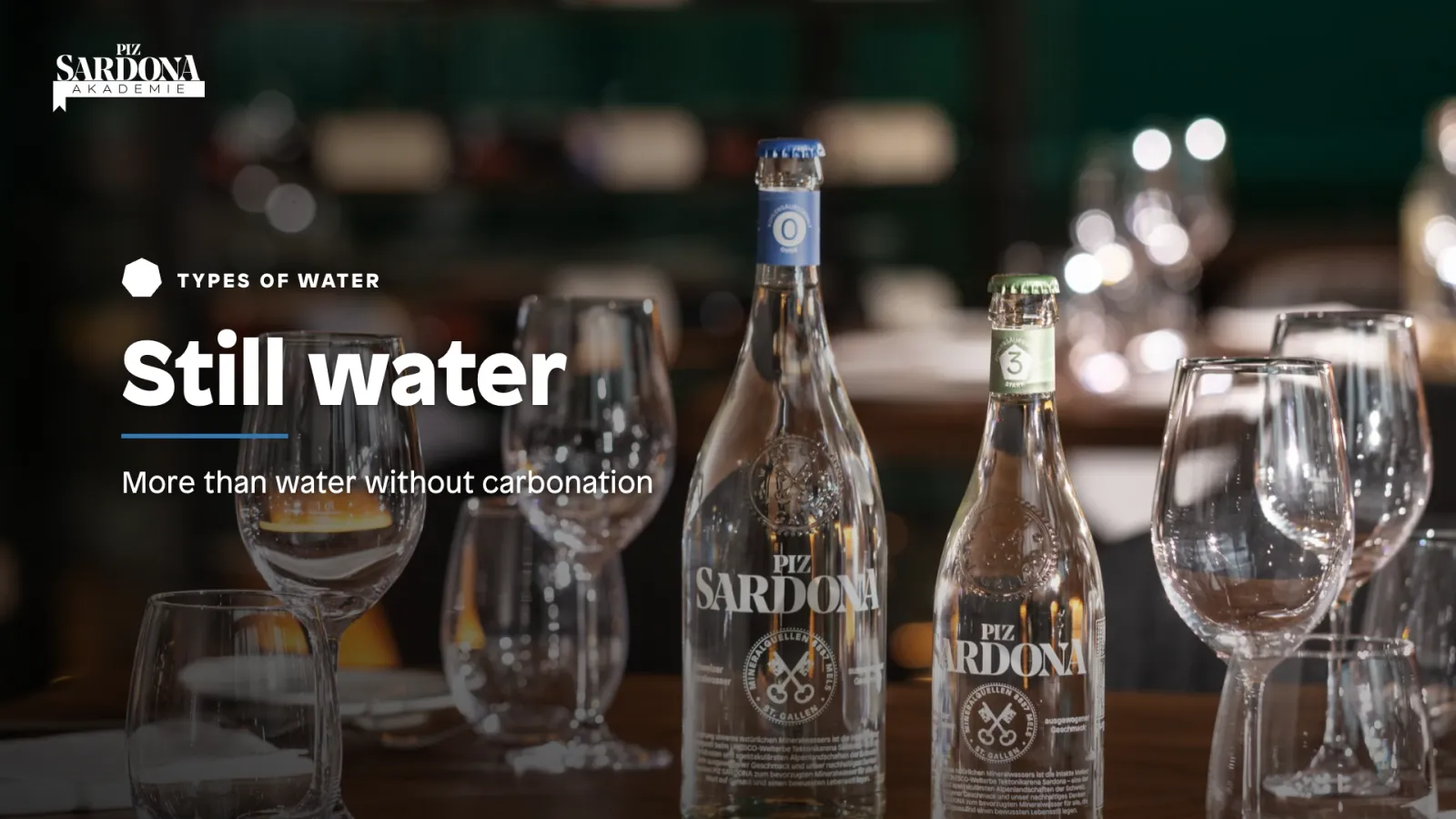
Short explainer video: what “still” means, why still water is no less fresh, how to recognise quality, whether it is healthier than sparkling water and which mineralisation suits coffee, tea and food. With a full transcript.
Published in October 2026
Read the articleTranscript
Still water: more than water without carbonation.
“Still”, “medium” or “sparkling”: these terms describe only the carbonation, and say nothing about origin, purity or minerals. Many springs, particularly in the Alps, are practically free of carbonation to begin with. So “still” is often the most natural form.
The impression of freshness comes largely from the carbonation: a purely sensory effect. Still mineral water is just as fresh from the spring. Without carbonation, a water shows its character undisguised: its mineralisation, its origin.
What reveals quality? Above all, the label. Total mineralisation shows how many dissolved minerals a litre contains. Calcium and magnesium shape water hardness. For a low-sodium diet, sodium is the most important figure.
Is still water healthier than sparkling? Not as a general rule. Both contribute equally to hydration. Some people find carbonated water less agreeable. If discomfort persists, it is best to have a doctor look into the cause.
For coffee and tea, the mineralisation matters: very hard water can mask aromas, extremely soft water quickly makes coffee taste flat. Medium, balanced values are considered a good basis.
In fine dining, still water is the first choice with food. It lets delicate aromas come to the fore. As a rule of thumb: a soft water with delicate dishes, a richer one with robust dishes, and across a whole menu, a balanced middle ground.
Piz Sardona, for example, sits in this middle ground: naturally alkaline, with a pH of 8.0, and 540 milligrams of minerals per litre.
More on this in the Piz Sardona Academy.
Piz Sardona
Alkaline mineral water with a pH of 8.0 from the Castels spring in Mels — filtered through the rock of the Sardona Alps for twelve years.
Our water