

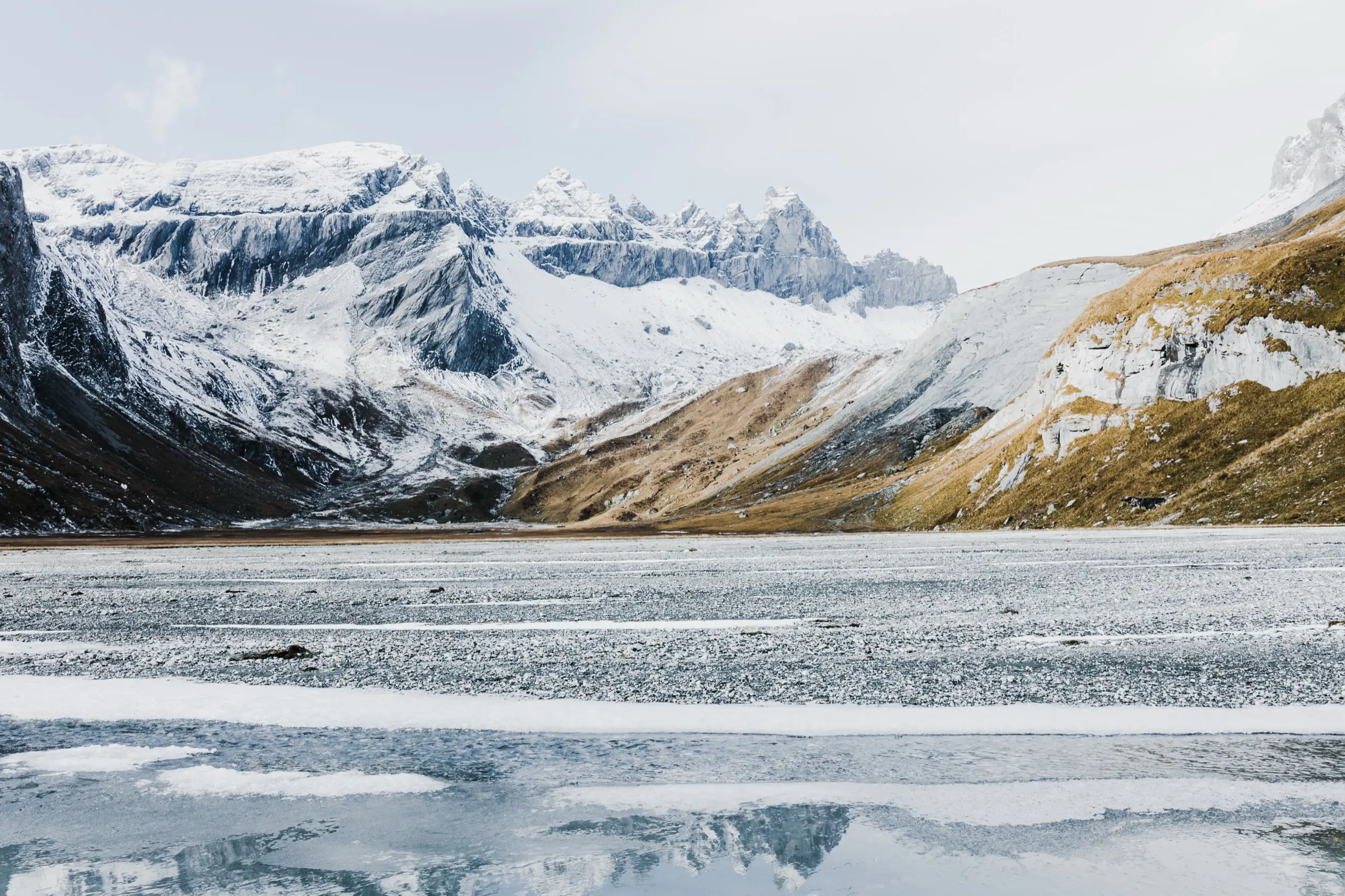
The catchment area of our mineral water lies in the heart of the Swiss Sardona Alps, at over 2,000 metres above sea level.
Our water travels through layers of rock and stone for around 12 years, re-emerging perfectly pure and enriched with minerals as alkaline mineral water.
The Castels spring
The water's journey
At over 2,000 metres above sea level, meltwater and precipitation seep into the ground. The mountains act as a natural filter: layer by layer, the rock holds back particles while the water dissolves minerals — calcium and hydrogen carbonate from the limestone, sulphate from sulphate-bearing strata.
After around twelve years it emerges in Mels in the Sarganserland from the Castels spring — naturally alkaline, with a pH of 8.0 at source. What legally separates mineral water from spring water is explained in our knowledge hub.
Spring water or mineral water
Unique worldwide
The UNESCO World Heritage Tectonic Arena Sardona is unique worldwide. Like every World Heritage Site, it possesses outstanding universal value.
The Tectonic Arena Sardona has been a UNESCO World Heritage Site since 2008 — one of the few sites worldwide inscribed for their geology alone. Across some 300 square kilometres, older rock lies on top of younger here: during the folding of the Alps, entire rock packages were thrust over each other for kilometres, and hardly anywhere else is this mountain-building process so clearly visible.
unesco-sardona.chThe namesake
Piz Sardona, 3,056 metres
Our water carries the name of the mountain above its source area: Piz Sardona stands where the cantons of St. Gallen, Glarus and Graubünden meet — high-alpine, remote and surrounded by one of Switzerland's most unspoilt mountain landscapes. We have dedicated a separate article to the summit and its surroundings.
Piz Sardona — the mountain
Frequently asked questions
Why is the Tectonic Arena Sardona a UNESCO World Heritage Site?
Because the making of mountains is visible here like hardly anywhere else: during the folding of the Alps, older rock packages were thrust over younger ones. The area has been a UNESCO World Heritage Site since 2008 — one of the few inscribed for geology alone.
Where is the Tectonic Arena Sardona?
In the border region of the cantons of St. Gallen, Glarus and Graubünden. The World Heritage Site covers some 300 square kilometres of mountain landscape around its namesake, Piz Sardona.
What does the World Heritage Site have to do with our water?
The catchment area of the Castels spring lies at over 2,000 metres within this area. From there the water travels through the rock for about twelve years before it is drawn in Mels.
How high is Piz Sardona?
3,056 metres above sea level. The summit stands where the cantons of St. Gallen, Glarus and Graubünden meet, and gave both the World Heritage Site and our water their name.
Can you visit the Tectonic Arena?
Yes. The area is well served by hiking trails, viewpoints and mountain huts — you'll find up-to-date information and activities on the official World Heritage website, unesco-sardona.ch.
Water knowledge