

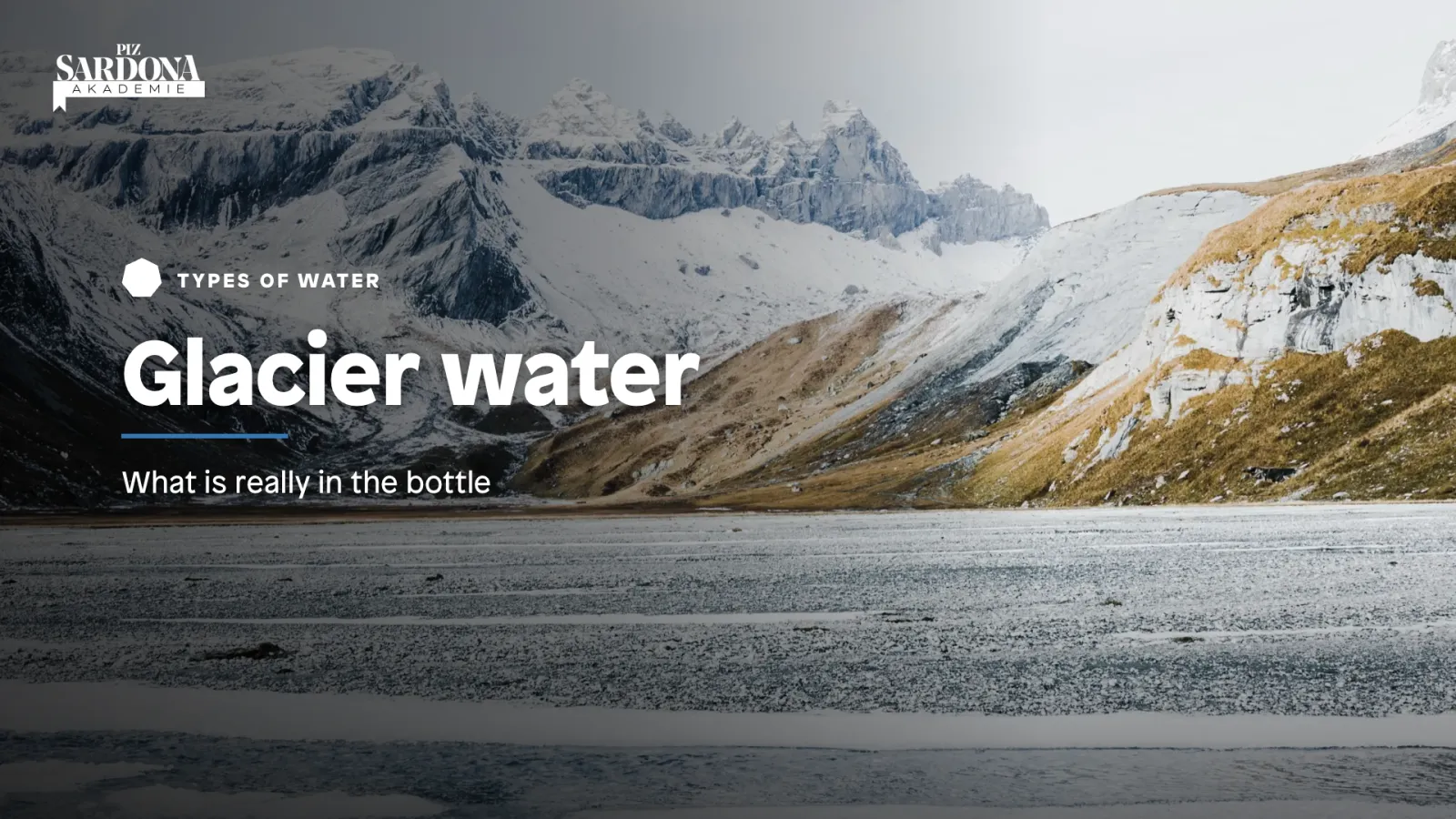
Short explainer video: what glacier water is, why it contains so few minerals, what the label reveals and how it differs from natural mineral water. With a full transcript.
Published in October 2026
Read the articleTranscript
Glacier water: what is really in the bottle.
Hardly any word sells water better than “glacier”. Yet glacier water is, first of all, just meltwater. And it is among the lowest-mineral waters of all.
Glacial streams are milky and cloudy from glacial flour, finely ground rock. What is bottled is, as a rule, clear water captured in the surroundings of a glacier. Drunk straight from the stream, the water is untested: surface water can carry rock flour and germs.
Why so low in minerals? Snow and ice contain hardly any dissolved minerals. Water dissolves minerals almost exclusively from rock, and that takes time: months and years. Meltwater drains away within hours to days. The result: very soft water. So “pure” here means: low in almost everything, including calcium and magnesium.
A category called “glacier water” does not exist in food law. The glacier on the label describes an origin, not a grade of quality. If the label says “natural mineral water”, strict requirements apply, complete with declared mineral values. If that statement is missing, the product is spring or drinking water.
Meltwater comes from the surface, drains away within days and carries barely any mineral signature. Natural mineral water often matures for years, protected underground. Both have their place: very soft water is well suited to tea, for instance.
The water of Piz Sardona seeps into the ground at more than 2,000 metres above sea level, then travels through the rock for around twelve years. On the way it takes up calcium, magnesium and sulphate and naturally reaches a pH of 8.0. Piz Sardona is therefore not a glacier water, even though its spring rises in the high mountains.
More on this in the Piz Sardona Academy.
Piz Sardona
Alkaline mineral water with a pH of 8.0 from the Castels spring in Mels — filtered through the rock of the Sardona Alps for twelve years.
Our water