

Water knowledge
Organic mineral water: does it exist — and what does ‘organic’ mean for water?
Is mineral water organic? The short answer: there is no state organic label for water, neither in Switzerland nor in the EU. The longer answer begins where bottles labelled ‘Bio-Mineralwasser’ (organic mineral water) stand on the shelf all the same. This article explains where the term comes from, what it promises and what it says about a water, and what it does not.
Updated October 2026 · 6 min read
In brief
- There is no state organic label for mineral water: the organic regulations of Switzerland and the EU only apply to agricultural products.
- ‘Bio-Mineralwasser’ is a designation used by private German seals, based on a 2012 ruling by the Federal Court of Justice. Austria does not allow it for mineral water.
- Many of the best mineral waters carry no organic seal. What sets a water apart is shown by its origin, its analysis and laboratory findings.
What ‘organic’ means for food
For food, ‘organic’ is a protected term. In Switzerland it is governed by the federal Organic Farming Ordinance, in the EU by the EU organic regulation. Both set out how organic farming has to work: no synthetic pesticides, no synthetic fertilisers, livestock kept in line with animal welfare and regular inspections from the field to the processed product. The Bud label of Bio Suisse goes further than the ordinance on many points.
All of these rules start with agriculture. But mineral water does not grow in a field. It forms when precipitation seeps into the ground in the mountains, travels through layers of rock for years, sometimes decades, and takes up minerals along the way until it emerges again at a spring. There is nothing to sow, fertilise or harvest. Water is therefore not considered an agricultural product, and the organic regulations do not apply. That is why there is no state organic label for mineral water, neither in Switzerland nor in the EU.
Where the term ‘organic mineral water’ comes from
That ‘Bio-Mineralwasser’ exists nonetheless goes back to a ruling by Germany’s Federal Court of Justice (Bundesgerichtshof) of 13 September 2012 (case I ZR 230/11). The court held the designation to be permissible if a water stands out from ordinary mineral waters because it contains particularly few residues and contaminants. Anyone reading ‘Bio-Mineralwasser’, the court said, expects an untreated water without additives whose residues and contaminants lie well below the maximum levels for natural mineral water.
Since then, two private bodies in Germany have awarded corresponding seals:
- The Qualitätsgemeinschaft Bio-Mineralwasser e.V. (Organic Mineral Water Association), founded in 2008 and supported by organic farming associations such as Bioland, Demeter and Naturland.
- SGS Institut Fresenius with its seal ‘Premiummineralwasser in Bio-Qualität’ (premium mineral water of organic quality).
Both bodies set their own, stricter limits, for example for nitrate or for pesticide residues, and also assess how sustainably the bottler operates. Which of the two seals meets the requirements of the Federal Court of Justice was the subject of court proceedings between the providers for years. For consumers, one thing matters above all: both seals are private quality marks, not a state organic logo. Inspections follow the criteria of the respective body, not an organic regulation.
How Switzerland and Austria handle it
The Federal Court of Justice ruling applies in Germany. Austria has answered the question differently: since 2019 the Austrian Food Code (Österreichisches Lebensmittelbuch) has stated that mineral waters may not carry the designation ‘bio’. In Switzerland, the Organic Farming Ordinance applies to agricultural products, and mineral water is not one of them. There is no state organic mark for mineral water here either.
If you see a bottle labelled ‘Bio-Mineralwasser’ in Switzerland, it is best to look at the seal. It tells you who tested the water and against which criteria. The word ‘organic’ on its own says little about water.
What every natural mineral water has to meet
Regardless of any seal, natural mineral water is the most strictly regulated category of water. It must come from an underground deposit protected from contamination and be of original purity. Disinfection is prohibited; only a few, narrowly limited processes are permitted, such as removing iron or adding carbon dioxide. It is bottled directly at the source, and its mineralisation must remain constant. The details are set out in the article on spring water and mineral water.
These rules are no guarantee, however, that no traces of human activity reach a deposit. In 2024 a test by the Swiss French-language broadcaster RTS found unwanted substances in four out of ten mineral waters, including pesticide residues. How well a spring is protected depends on the geology, the catchment area and the time the water spends underground. In the end, only the analysis can show it.
What to look for when buying
With or without a seal: some details on the label say more about a water than the word ‘organic’.
- The designation: ‘natural mineral water’ is legally protected and tied to the conditions above. The label also gives the name of the spring and the place of bottling.
- The analysis: natural mineral water carries a table of its characteristic mineral values. It shows what defines a water and makes waters comparable with one another.
- Treatment notes: statements such as ‘carbonated’ or ‘iron removed’ show which of the few permitted processes have been applied.
- The seal: an organic mineral water seal names the body that carried out the testing. What the seal means is determined by that body’s criteria.
- The packaging: whether returnable glass or single-use has a bearing on a bottle’s environmental footprint, regardless of its contents.
Is Piz Sardona organic?
Not in the sense of a seal. There is no state organic label for mineral water. What can be documented is something else: Piz Sardona is a natural mineral water from the Castels spring in Mels. The water seeps into the ground in an area above 2,000 m above sea level, by the UNESCO World Heritage Tectonic Arena Sardona, and then travels through layers of rock and stone for around twelve years before it is bottled at the source. Where that path begins is shown on the page about the Origin.
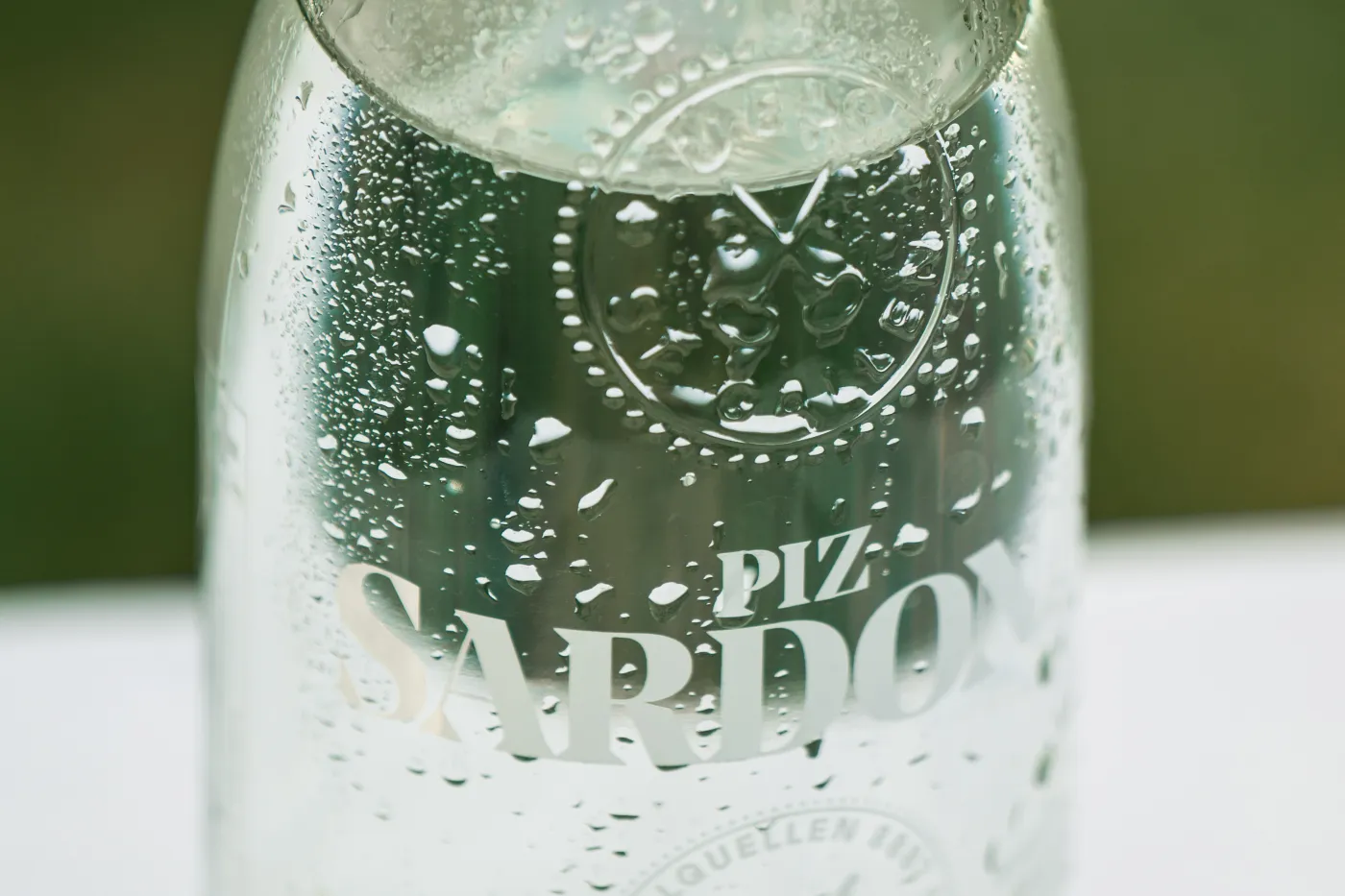
The still variety goes into the bottle without added carbon dioxide; carbon dioxide is added to the sparkling varieties, one of the few permitted processes. Mineralquellen Mels AG had its water tested for PFAS by the independent laboratory SGS Institut Fresenius in Germany, and no traces could be detected. What such a finding means is explained in the article on PFAS in water. You will find the analysis of the Castels spring on the page our water.
Frequently asked questions
Is there such a thing as organic mineral water?
Yes and no. There is no state organic label for mineral water, neither in Switzerland nor in the EU, because the organic regulations only apply to agricultural products. In Germany, however, mineral waters may be called ‘Bio-Mineralwasser’ following a 2012 ruling by the Federal Court of Justice, provided their residues and contaminants lie well below the legal maximum levels. This is checked by private bodies, not under an organic regulation.
What is the difference between organic mineral water and ordinary mineral water?
Both are natural mineral waters and meet the same legal requirements: a protected underground deposit, original purity, no disinfection, bottling at the source. An organic mineral water has additionally been tested by a private body that sets stricter limits, for example for nitrate or pesticide residues, and assesses the bottler’s sustainability. A mineral water without a seal can meet such values too; it simply has not been certified.
Is Piz Sardona mineral water organic?
Piz Sardona is a natural mineral water from the Castels spring in Mels: the water seeps into the ground above 2,000 m above sea level by the UNESCO World Heritage Tectonic Arena Sardona and travels through the rock for around twelve years. According to Mineralquellen Mels AG, the independent laboratory SGS Institut Fresenius in Germany confirmed in writing that no traces of PFAS could be detected. The composition is shown in the analysis on the ‘our water’ page.
Why does the organic regulation not apply to mineral water?
Because it was written for agriculture. The organic regulation governs how crops are grown, animals are kept and agricultural products are processed. Mineral water is neither grown nor harvested but tapped at a spring; the criteria of organic farming cannot be applied to it. This holds for the Swiss Organic Farming Ordinance as much as for the EU organic regulation and its organic logo.
Read next
Spring water or mineral water? The difference is defined by law
Spring water or mineral water? Learn how Swiss food law separates the two categories and how to recognise them on the label.
ReadPFAS in water: what a laboratory analysis shows — and what it does not
What PFAS are, why they are regulated and what a laboratory analysis says: why ‘no traces detected’ means something other than ‘not present’.
ReadSwiss mineral water: what makes the springs of the Alps special
Why the Alps make Switzerland a land of water: geology, strict regulations, short transport routes and the diversity of Swiss mineral waters at a glance.
ReadPiz Sardona
Alkaline mineral water with a pH of 8.0 from the Castels spring in Mels — filtered through the rock of the Sardona Alps for twelve years.
Our water