

Residues of plant protection products in groundwater have been a concern in Switzerland for years, and by now for the mineral water industry as well: tests have found traces in a few mineral waters, and in French-speaking Switzerland, according to media reports, a bottler has set aside some of its springs because their water contained residues of plant protection products. This article explains where these substances come from, why some springs are affected and others are not — and why one thing counts above all: where the water seeps into the ground.
In brief
- Pesticides in groundwater come mainly from agriculture: plant protection products and their persistent breakdown products seep down from arable fields, vineyards and orchards.
- Mineral springs can be affected too if their catchment area lies in an arable farming region. Filtering out residues is not permitted for natural mineral water.
- The water of Piz Sardona seeps into the ground above 2,000 m above sea level, in an area without arable fields or speciality crops. According to Mineralquellen Mels AG, no pesticides are detectable, as is required of every natural mineral water.
What is meant by pesticides
‘Pesticides’ is the umbrella term for plant protection products and biocidal products. In agriculture, the term refers to plant protection products: herbicides against weeds, fungicides against fungi, insecticides against insects. Between 2010 and 2020, an average of around 2,100 tonnes of active substance was sold in Switzerland each year, almost half of it fungicides. Of the quantity that can be attributed to a specific crop, 44 per cent goes to arable farming, 21 per cent to vineyards and 17 per cent to fruit growing (Agroscope).
In the soil, the active substances are broken down. This produces breakdown products, known as metabolites. Some of them are more persistent and more mobile than the active substance itself, and it is these that are found most often in groundwater today. Active substances exceed the value of 0.1 micrograms per litre at 1 to 2 per cent of the monitoring sites of NAQUA, the National Groundwater Monitoring; breakdown products do so at almost one site in three, and on the Swiss Plateau at around 50 per cent (FOEN).
Fertiliser is a different matter. It brings nutrients to the field, above all nitrogen, from which nitrate forms in the soil. Nitrate is not a pesticide, but it is likewise a consequence of intensive agriculture: nationwide it exceeds the numerical requirement of 25 milligrams per litre at around one in seven NAQUA monitoring sites, and in areas with arable and vegetable farming at around half of them (FOEN).
From field to groundwater
On the field
- Plant protection products against fungi, weeds and insects
- Fertiliser for plant growth
In the soil
- Active substances decompose into breakdown products, the metabolites
- The nitrogen in fertiliser turns into nitrate
In the groundwater
- Persistent metabolites and nitrate seep down with the rain
- They can stay there for years or decades
A ban stops new inputs, not what is already underground.
How the substances reach groundwater
Rain washes active substances and breakdown products down through the soil. How much arrives at depth depends on the substance, the soil and the subsurface. The best-known example of recent years is chlorothalonil, a fungicide that had been used since the 1970s on cereals, potatoes, vegetables and vines, among other crops. In December 2019 the federal government withdrew its authorisation with immediate effect; since 1 January 2020 it may no longer be used (Eawag).
Its breakdown products, however, have remained. In 2025 the most frequently found of them exceeded 0.1 micrograms per litre at just under one in four NAQUA monitoring sites, and on the Swiss Plateau at around 40 per cent (FOEN). In arable farming areas, chlorothalonil breakdown products exceed this value at around 65 per cent of monitoring sites (FOEN). Concentrations are now falling: between 2020 and 2025, the share of monitoring sites with chlorothalonil breakdown products above 0.1 micrograms per litre fell from 33 to 23 per cent (FOEN). The decline is slow, because groundwater takes years to renew itself. The herbicide atrazine has been banned for more than ten years, yet its breakdown products can still be detected today. What this means for tap water is explained in the article on pesticides in drinking water.
Why mineral water can be affected too
Natural mineral water comes from underground deposits fed by precipitation. The law requires original purity, and the Federal Food Safety and Veterinary Office (FSVO) states that trace substances of human origin, such as pesticides and their breakdown products, must not occur in it at all (FSVO). There is no legal maximum level for them; a guide value of 0.1 micrograms per litre for the sum of all quantified pesticides and their relevant breakdown products serves as an indicator of purity. Precipitation, however, seeps into the ground where it falls. If the catchment area of a spring lies in an arable farming region, the substances can reach a mineral water deposit as well.
Tests show that this does happen, albeit rarely and in small quantities. In a 2024 test of ten mineral waters by the Swiss French-language broadcaster RTS, two laboratories found unwanted substances in four products, in one of them breakdown products of the pesticides chlorothalonil and chloridazon (RTS, Kassensturz). In a campaign published in 2023, the Office for Food Safety and Veterinary Affairs of the Canton of Basel-Landschaft found trace substances of human origin in 2 of 35 mineral water samples from Switzerland and abroad, including a pesticide breakdown product (Canton of Basel-Landschaft). In a 2022 test by the magazine K-Tipp, the laboratory found no pesticides in any of the twelve Swiss mineral waters tested (K-Tipp).
A case from French-speaking Switzerland shows what it looks like when springs are contaminated. A large bottler had filtered its natural mineral water through activated carbon from 2008 to 2022, which is not permitted. In 2025 the Vaud Public Prosecutor’s Office ordered the company to pay a compensatory claim; according to the Public Prosecutor’s Office, the water posed no danger either before or after filtration, and the company accepted the decision (Le Temps, Canton of Vaud). Since the filters were removed at the end of 2022, production has complied with the law, according to the Vaud Council of State (Canton of Vaud). According to a March 2023 report by the Vaud cantonal chemist, covered by RTS and SRF in 2026, some springs have since been set aside and the water from the remaining ones blended; the media reports name residues of chlorothalonil as the main reason (RTS, SRF). Which filters are permitted for natural mineral water, and why residues may not be filtered out, is explained in the article Can mineral water be filtered?
The catchment area makes the difference
For every spring, what counts is what happens above it: where the precipitation seeps into the ground and what ends up on the soil there. Eawag, the water research institute of the ETH Domain, sums it up for chlorothalonil as follows: exceedances are to be expected mainly in groundwater whose catchment area is used for arable farming. Groundwater with a catchment area at higher altitude and without arable farming is probably not contaminated, or only slightly so (Eawag).
The measurements paint the same picture. In the evaluation of the 2014 data, residues of plant protection products were found at almost all NAQUA monitoring sites whose catchment area is dominated by arable farming. At the monitoring sites in the Alps and Prealps, whose surroundings consist of summer pastures and unproductive land, by contrast, almost none were found (FOEN, NAQUA report 2019). Arable farming itself is concentrated at low altitudes in Switzerland: in 2024, 95 per cent of open arable land lay in the valley and hill zones, while in the highest mountain zone it amounted to 63 hectares (Agristat).
What happens above a spring
Catchment with arable farming
- Fields, vegetables, orchards or vineyards
- Plant protection products and fertiliser on the land
- Breakdown products and nitrate can seep into the groundwater with the rain
Infiltration area in the high mountains
- Rock, scree and alpine pastures
- No arable fields, no vegetable or fruit crops, no vineyards
- The water seeps down through layers of rock
What is applied in the catchment area helps determine what can reach the groundwater. Whether residues actually arrive there is ultimately shown by the analysis.
A long residence time underground does not in itself offer protection. Water tapped today seeped into the ground years ago and carries the traces of how the land was used at that time. If there used to be arable farming in the catchment area, a deposit can still contain residues years after a ban. Groundwater tappings in the public interest must be surrounded by protection zones. For contaminated tappings, the cantons must also designate the inflow area from which around 90 per cent of the water originates, and they can restrict the use of plant protection products and fertiliser there (FOEN).
What a laboratory finding says
Whether a water contains residues is ultimately shown by the analysis. ‘Not detectable’ means that the substances looked for lay below the limit of detection of the method. A finding becomes meaningful when it is known which laboratory carried out the measurement and when, which active substances and breakdown products were looked for and how low the limit of detection was. An analysis can show that nothing is detectable; it cannot prove that a substance is present in no quantity whatsoever. More on this in the article on PFAS in water.
What applies to Piz Sardona
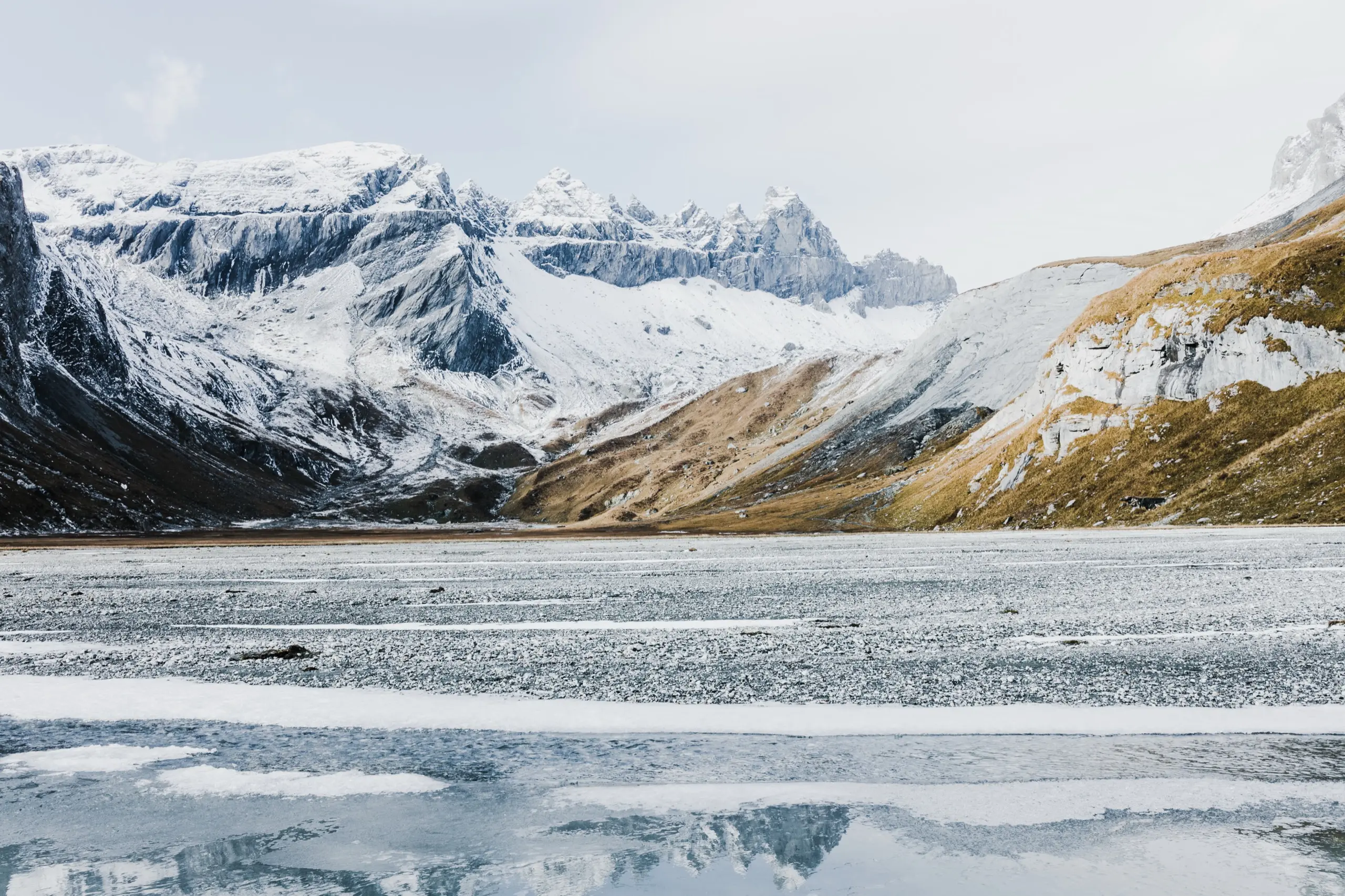
The water of Piz Sardona seeps into the ground in the Sardona Alps above 2,000 m above sea level, by the UNESCO World Heritage Tectonic Arena Sardona. In the infiltration area there are no arable fields, no vegetable or fruit crops and no vineyards, and so none of the land on which most of the plant protection products in Switzerland are applied. The water then travels through layers of rock and stone for around twelve years until it is tapped from the Castels spring in Mels. The whole journey is shown on the Origin page.
According to Mineralquellen Mels AG, no pesticides are detectable in the water of Piz Sardona; no public information is available on the laboratory, the date, the scope of testing or the limit of detection. For a natural mineral water, this is not a distinguishing feature but a requirement for the entire category: trace substances of human origin must not occur in it at all. What Piz Sardona brings to this is its origin: an infiltration area in the high mountains without arable fields or speciality crops. Mineralquellen Mels AG had its water tested for PFAS by the independent laboratory SGS Institut Fresenius in Germany, and no traces could be detected. The mineral analysis of the Castels spring and the PFAS finding can be found on the our water page.
Was this article helpful?
Frequently asked questions
Does mineral water contain pesticides?
Generally not in measurable quantities, though not in every case. Tests have found traces of pesticides or their breakdown products in a few mineral waters, mostly in very small quantities. According to the FSVO, such substances must not occur in natural mineral water at all, nor may they be filtered out. The catchment area is therefore decisive: if it lies in an arable farming region, even a protected deposit can become contaminated.
Where do pesticides in groundwater come from?
Mainly from agriculture. Plant protection products are applied to fields, vineyards and orchards; in the soil they decompose into breakdown products, which can seep into groundwater with the rain. The Swiss Plateau, with its arable farming areas, is the most affected. Fertiliser is a different source: it gives rise to nitrate, which is also measured in groundwater but is not a pesticide.
Are pesticides detectable in Piz Sardona?
According to Mineralquellen Mels AG, no: no pesticides are detectable in the water of Piz Sardona. This matches the requirement for every natural mineral water; what sets Piz Sardona apart is its origin. The water seeps into the ground above 2,000 m above sea level in the Sardona Alps, in an area without arable fields, vegetable or fruit crops and without vineyards, and then travels through layers of rock and stone for around twelve years until it is tapped from the Castels spring in Mels.
Is there such a thing as ‘pesticide-free’ mineral water?
A laboratory can show that the substances looked for lay below the limit of detection, in other words that they are not detectable. No analysis provides proof of complete absence, which is why ‘not detectable’ is the more accurate statement. For natural mineral water, the law requires original purity. The best precondition for this is a catchment area without arable farming or speciality crops.
Ask the Academy
Still have a question? Ask us. We will answer it and publish it here below the article. Medical questions about individual cases, however, belong with a doctor.
Poll
How do you like your water best?
Read next
Why no pesticides are detectable in Piz Sardona
No pesticides are detectable in Piz Sardona water. Why the infiltration area is decisive and why we don’t say ‘pesticide-free’.
ReadPesticides in drinking water: what chlorothalonil means for Switzerland
Chlorothalonil and other pesticides in Swiss groundwater: where the values are exceeded, what water utilities are doing and what it means for mineral water.
ReadCan mineral water be filtered? What is permitted — and what is not
Activated carbon, UV light, chlorine: what is allowed for tap water is prohibited for natural mineral water. Which processes the law permits, and why.
ReadPiz Sardona
Alkaline mineral water with a pH of 8.0 from the Castels spring in Mels — filtered through the rock of the Sardona Alps for twelve years.
Our water