

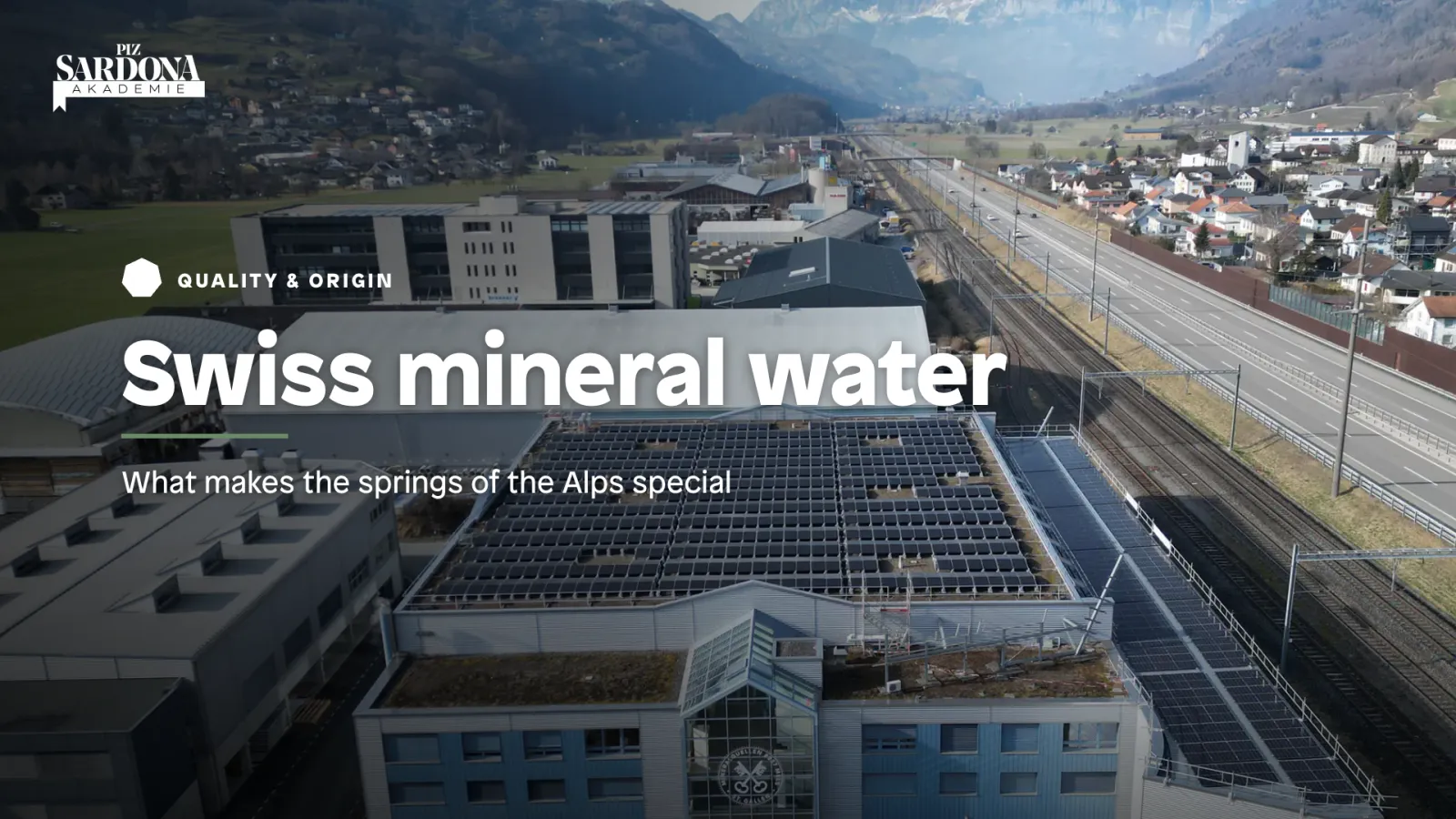
Short explainer video: why Switzerland is called the ‘water tower of Europe’, how the rock shapes the character of a mineral water, what requirements natural mineral water must meet and why origin is not a judgement of quality. With a full transcript.
Published in October 2026
Read the articleTranscript
Swiss mineral water: what makes the springs of the Alps special.
The Rhine, the Rhône, the Inn and the Ticino all rise in the Swiss mountains. That is why Switzerland is called the ‘water tower of Europe’. This small country stores around 6 per cent of Europe’s freshwater reserves.
The Alps hold precipitation as snow and glacier ice and release it again over the course of months. Part of it feeds the great rivers. Another part seeps into the rock and sometimes travels for years or decades. This path leads to mineral water.
Along the way, the water dissolves traces of the rock. Limestone and dolomite release calcium and magnesium. Gypsum and anhydrite are the source of sulphate, which can lend a subtly astringent note. Granite and gneiss release very little: such waters remain lightly mineralised.
Swiss mineral waters range from under 100 to well over 1,000 milligrams per litre. One example from the middle range is the Castels spring near Mels, with 540 milligrams of minerals per litre. One spring among many.
In Switzerland, ‘natural mineral water’ is a protected designation. The requirements are an underground source, protected from contamination, original purity, bottling at the spring and a constant composition.
Water is heavy: a full glass bottle easily weighs one and a half kilograms. Choosing Swiss mineral water in Switzerland keeps transport routes short. Returnable glass completes many cycles.
This is not a judgement on imported waters: other countries have excellent springs too. Origin is a characteristic, not a judgement of quality. In the end, composition and taste decide whether a water is the right fit.
More on this in the Piz Sardona Academy.
Piz Sardona
Alkaline mineral water with a pH of 8.0 from the Castels spring in Mels — filtered through the rock of the Sardona Alps for twelve years.
Our water