

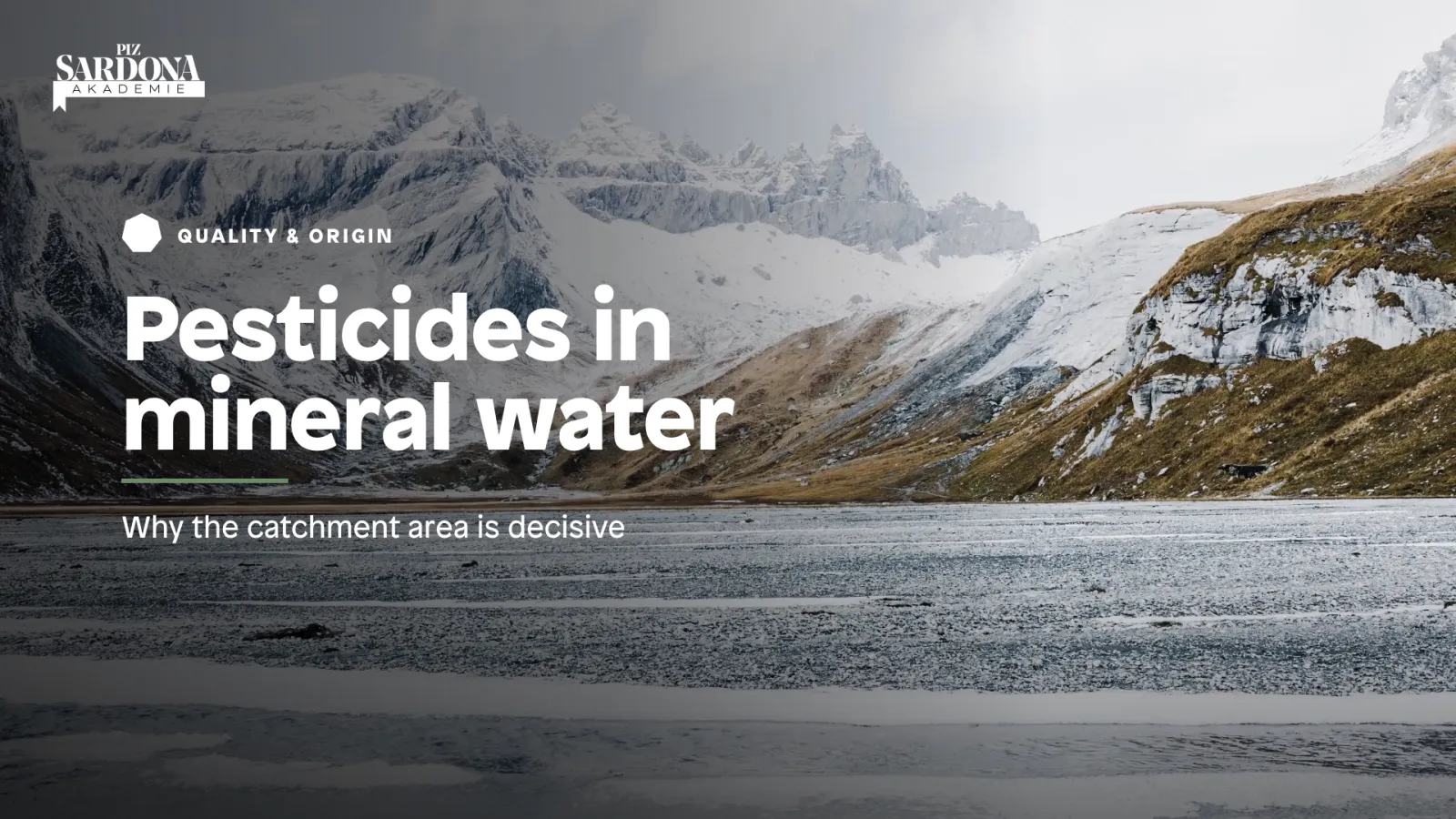
Short explainer video: how pesticides and their breakdown products get into groundwater, why residues may not be filtered out of natural mineral water and what sets the Piz Sardona catchment area apart. With a full transcript.
Published in October 2026
Read the articleTranscript
Pesticides in mineral water: why the catchment area is decisive.
In agriculture, pesticides are plant protection products: herbicides against weeds, fungicides against fungi, insecticides against insects. In the soil they decompose into breakdown products. Some of them reach the groundwater.
Rain washes active substances and breakdown products through the soil and down into the groundwater. Fertiliser produces nitrate in the soil: not a pesticide, but likewise a consequence of intensive agriculture. A ban stops new inputs, not what is already underground.
The best-known example is the fungicide chlorothalonil. Since 2020 it may no longer be used. Its breakdown products, however, have remained: in arable farming areas they exceed 0.1 micrograms per litre at around 65 per cent of monitoring sites.
Natural mineral water is fed by precipitation. If the catchment area of a spring lies in an arable farming region, the substances can reach it as well. Filtering out residues is not permitted for natural mineral water: it has to be pure at the source.
That is why the catchment area makes the difference. For chlorothalonil, Eawag notes that groundwater with a catchment area at higher altitude and without arable farming is probably not contaminated, or only slightly so.
The water of Piz Sardona seeps into the ground at more than 2,000 metres above sea level, in an area without arable fields, vegetable or fruit crops and without vineyards. It then travels through the rock for around twelve years. According to Mineralquellen Mels AG, no pesticides are detectable in it, as is required of every natural mineral water.
More on this in the Piz Sardona Academy.
Piz Sardona
Alkaline mineral water with a pH of 8.0 from the Castels spring in Mels — filtered through the rock of the Sardona Alps for twelve years.
Our water