

Just over 80 per cent of Swiss drinking water comes from groundwater. Since 2019 it has been known that breakdown products of the fungicide chlorothalonil occur in it across large parts of the Swiss Plateau, in many places above the value of 0.1 micrograms per litre. This article sets out the context: what is measured, who is affected, what water utilities are doing and what applies to natural mineral water.
In brief
- Just over 80 per cent of Swiss drinking water comes from groundwater. Pesticide breakdown products are above 0.1 micrograms per litre at almost one in three NAQUA monitoring sites, and at around 50 per cent of the sites on the Swiss Plateau.
- Chlorothalonil was banned at the end of 2019, but its breakdown products remain. According to an FSVO estimate, around a tenth of the population drank water with breakdown products above the maximum level between 2019 and 2021; the authorities see no short-term health risk.
- Tap water may be treated to remove pesticides; natural mineral water may not. For mineral water, the catchment area is decisive.
Where drinking water comes from
Groundwater, spring water included, covers just over 80 per cent of Switzerland’s drinking water needs. It is tapped at around 12,000 sites. Almost 70 per cent of the groundwater tapped goes into the supply network either directly or after simple treatment, for example in a UV unit. Just under 20 per cent of drinking water comes from lakes and undergoes more extensive treatment (FOEN). How clean tap water is therefore depends above all on how clean the groundwater is.
Its condition is monitored at more than 600 sites by NAQUA, the National Groundwater Monitoring run by the Federal Office for the Environment (FOEN). For groundwater used as drinking water, a value of 0.1 micrograms per litre applies to each pesticide. In drinking water itself, a maximum level of the same amount applies to each active substance and to each breakdown product classified as relevant; for the sum of all pesticides it is 0.5 micrograms per litre (Drinking Water Ordinance).
Chlorothalonil: a fungicide with a long legacy
Chlorothalonil was widely used in Switzerland from the 1970s onwards, on cereals, potatoes, vegetables and vines, among other crops. Between 2008 and 2018, 32 to 66 tonnes were sold each year. In 2019, measurements showed that its breakdown products were widespread in groundwater and drinking water. The European Food Safety Authority EFSA and the Federal Food Safety and Veterinary Office (FSVO) could not rule out a health hazard for some of them. In December 2019 the federal authorities withdrew the authorisation of plant protection products containing chlorothalonil with immediate effect (Eawag, Federal Council).
The breakdown products have remained. In 2025 the most common of them was above 0.1 micrograms per litre at just under one in four NAQUA monitoring sites, and at around 40 per cent of the sites on the Swiss Plateau. Values above 0.1 micrograms occur in 16 cantons (FOEN). In arable farming areas, chlorothalonil breakdown products are above this value at around 65 per cent of monitoring sites (FOEN). Concentrations are now falling: between 2020 and 2025, the share of monitoring sites with chlorothalonil breakdown products above 0.1 micrograms per litre fell from 33 to 23 per cent (FOEN). But the substances are extremely persistent. According to an estimate made in 2024 on behalf of the FSVO, it is likely to take years to decades at many abstraction points before the values drop significantly (FSVO).
From field to groundwater
On the field
- Plant protection products against fungi, weeds and insects
- Fertiliser for plant growth
In the soil
- Active substances decompose into breakdown products, the metabolites
- The nitrogen in fertiliser turns into nitrate
In the groundwater
- Persistent metabolites and nitrate seep down with the rain
- They can stay there for years or decades
A ban stops new inputs, not what is already underground.
Relevant or not: an open legal question
Whether the maximum level of 0.1 micrograms per litre applies to a breakdown product in drinking water depends on whether it is classified as ‘relevant’. The FSVO classifies all breakdown products of chlorothalonil as relevant. Since 1 August 2026, twelve of them, including those found most often, have been expressly named on the list of relevant breakdown products in the Drinking Water Ordinance (FSVO, Drinking Water Ordinance).
The manufacturer of the active substance took the matter to court. In March 2026 the Federal Administrative Court upheld the ban but, in the authorisation proceedings, assessed four breakdown products as not relevant, including the two found most often (Federal Administrative Court). The FSVO points out that the court did not rule on the lawfulness of its approach to drinking water, and cantons such as Fribourg and Vaud continue to require measures (Canton of Fribourg, Canton of Vaud). Further assessments are under way at federal level (Canton of Vaud).
Who is affected
According to an FSVO estimate, between 2019 and 2021 around a tenth of the population drank water in which chlorothalonil breakdown products were above the maximum level (Federal Council). Those mainly affected are municipalities on the Swiss Plateau whose water comes from groundwater beneath arable land. At the end of September 2026 the FSVO listed just under 300 water supply systems in eleven cantons for which measures have been ordered; the deadlines extend in some cases to 2031, and in one case to 2036 (FSVO).
Chlorothalonil is not the only case. Breakdown products of other active substances also exceed the value of 0.1 micrograms per litre at monitoring sites across the country, for example those of the herbicides chloridazon and metolachlor. Plant protection products containing chloridazon have not been authorised since 2022, and the same has applied to products containing metolachlor since 2025. Overall, pesticide breakdown products are above this value at almost one in three NAQUA monitoring sites, and at around 50 per cent of the sites on the Swiss Plateau (FOEN).
Is tap water dangerous?
The authorities stress that the maximum level of 0.1 micrograms per litre is a precautionary value. In their assessment, tap water containing chlorothalonil breakdown products above this value poses no short-term health risk and can still be drunk; the Canton of Fribourg states that the exceedance is not indicative of a scientifically recognised health risk (Canton of Vaud, Canton of Fribourg). Water utilities must nevertheless remedy exceedances, and they are required to inform their customers regularly about water quality. Details on local tap water are available from the municipality or the water utility.
What water utilities are doing
Simple measures come first: taking contaminated abstraction points out of service, blending contaminated water with uncontaminated water or obtaining water from neighbouring supply systems. In the longer term come new abstraction points, regional interconnecting pipelines and the protection of inflow areas. The Federal Council regards technical treatment as a last resort and as a temporary solution (Federal Council).
Treatment is not straightforward. The most important breakdown products of chlorothalonil, the sulfonic acids, barely react to UV light or ozone. Activated carbon retains them only to a limited extent and has to be replaced frequently. Reverse osmosis removes them almost completely but produces a concentrate, and the purified water then has to be remineralised or blended (Eawag). One example from the Seeland region: in 2025 a regional water utility put a plant using finely ground activated carbon into operation, at a cost of around 2 million francs (SRF).
What about mineral water?
Natural mineral water is subject to different rules from tap water. It must be of original purity: trace substances of human origin, such as pesticides and their breakdown products, must not be present in it at all, nor may they be removed (FSVO). For a mineral spring, the catchment area has to deliver what a water utility is allowed to achieve with activated carbon or membranes. The reasons are explained in the article Can mineral water be filtered?
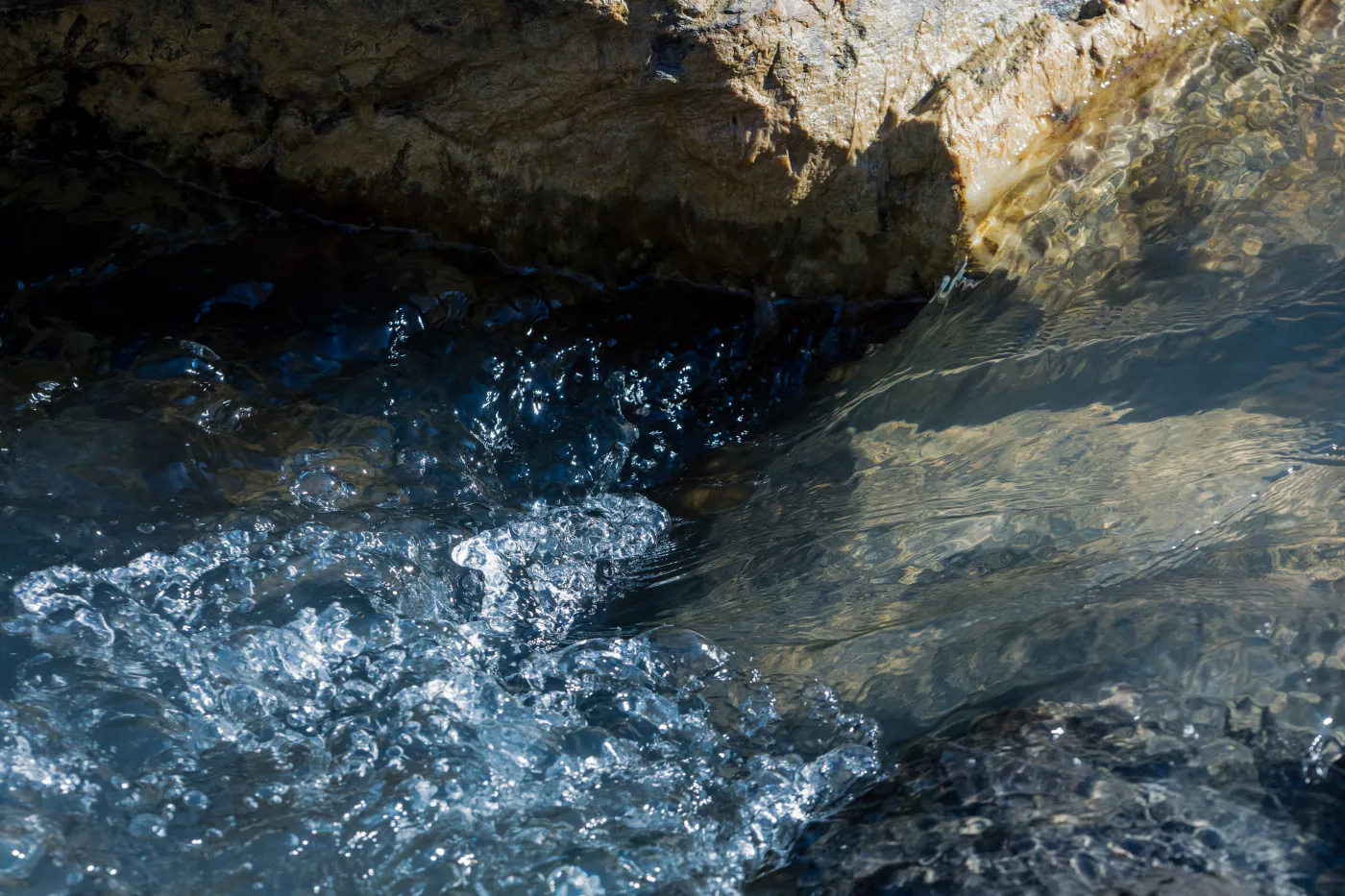
The water of Piz Sardona seeps into the ground in an area above 2,000 m above sea level in the Sardona Alps, by the UNESCO World Heritage Tectonic Arena Sardona. In this infiltration area there are no arable fields, no vegetable or fruit crops and no vineyards. The water then travels through layers of rock and stone for around twelve years before it is tapped at the Castels spring in Mels. According to Mineralquellen Mels AG, no pesticides can be detected in it, as the original purity of any natural mineral water requires. More on the role of the catchment area can be found in the article Pesticides in mineral water.
Was this article helpful?
Frequently asked questions
Is chlorothalonil in drinking water dangerous?
In the authorities’ assessment there is no short-term health risk; the maximum level of 0.1 micrograms per litre is a precautionary value. Because the European Food Safety Authority EFSA and the FSVO could not rule out a health hazard for some breakdown products, the FSVO classifies all chlorothalonil breakdown products as relevant; the maximum level applies to them, and water utilities must remedy exceedances. This is legally disputed: in 2026 the Federal Administrative Court assessed four breakdown products as not relevant in the authorisation proceedings, while the FSVO maintains its classification for drinking water.
How can residents find out whether their tap water is affected?
Water utilities are required to inform their customers regularly about the quality of the drinking water. The information can usually be found on the website of the municipality or the water utility. The FSVO also publishes a list of the water supply systems for which cantons have ordered measures because of chlorothalonil.
Can pesticides be filtered out of water?
For tap water, to some extent. The most important breakdown products of chlorothalonil can be removed almost completely by reverse osmosis, but only to a limited extent by activated carbon; UV light and ozone have little effect on them. Such plants are expensive, and it often takes years before they go into operation. For natural mineral water, removing pesticides is not permitted: the water must already be pure at the source.
How long do the breakdown products remain in groundwater?
Years to decades, depending on the subsurface. According to an estimate made in 2024 on behalf of the FSVO, concentrations at wells near rivers and at springs tapped in unconsolidated sediments are likely to drop significantly within five to ten years; in karst and fractured-rock areas it can take longer. The herbicide atrazine shows how slowly groundwater recovers: it has been banned for more than ten years, yet its breakdown products can still be detected today.
Ask the Academy
Still have a question? Ask us. We will answer it and publish it here below the article. Medical questions about individual cases, however, belong with a doctor.
Poll
How do you like your water best?
Read next
Pesticides in mineral water: why the catchment area is decisive
How do pesticides get into mineral water? What tests have found, why the catchment area of a spring is decisive and what applies to Piz Sardona.
ReadCan mineral water be filtered? What is permitted — and what is not
Activated carbon, UV light, chlorine: what is allowed for tap water is prohibited for natural mineral water. Which processes the law permits, and why.
ReadSwiss mineral water: what makes the springs of the Alps special
Why the Alps make Switzerland a land of water: geology, strict regulations, short transport routes and the diversity of Swiss mineral waters at a glance.
ReadPiz Sardona
Alkaline mineral water with a pH of 8.0 from the Castels spring in Mels — filtered through the rock of the Sardona Alps for twelve years.
Our water