

Pesticides in Swiss groundwater: when individual mineral water springs in the lowlands are struggling with the traces of decades of agriculture, it is worth taking a look at the map. Why the infiltration area is decisive — and why, for a natural mineral water, no filter is a substitute for origin.
In brief
- No pesticides are detectable in Piz Sardona water, as the original purity of every natural mineral water requires. The laboratory report is available on request.
- The infiltration area determines whether a mineral water contains pesticides. No filter can change the origin after the fact.
- We deliberately say ‘not detectable’ and not ‘pesticide-free’: an analysis only finds what it looks for.
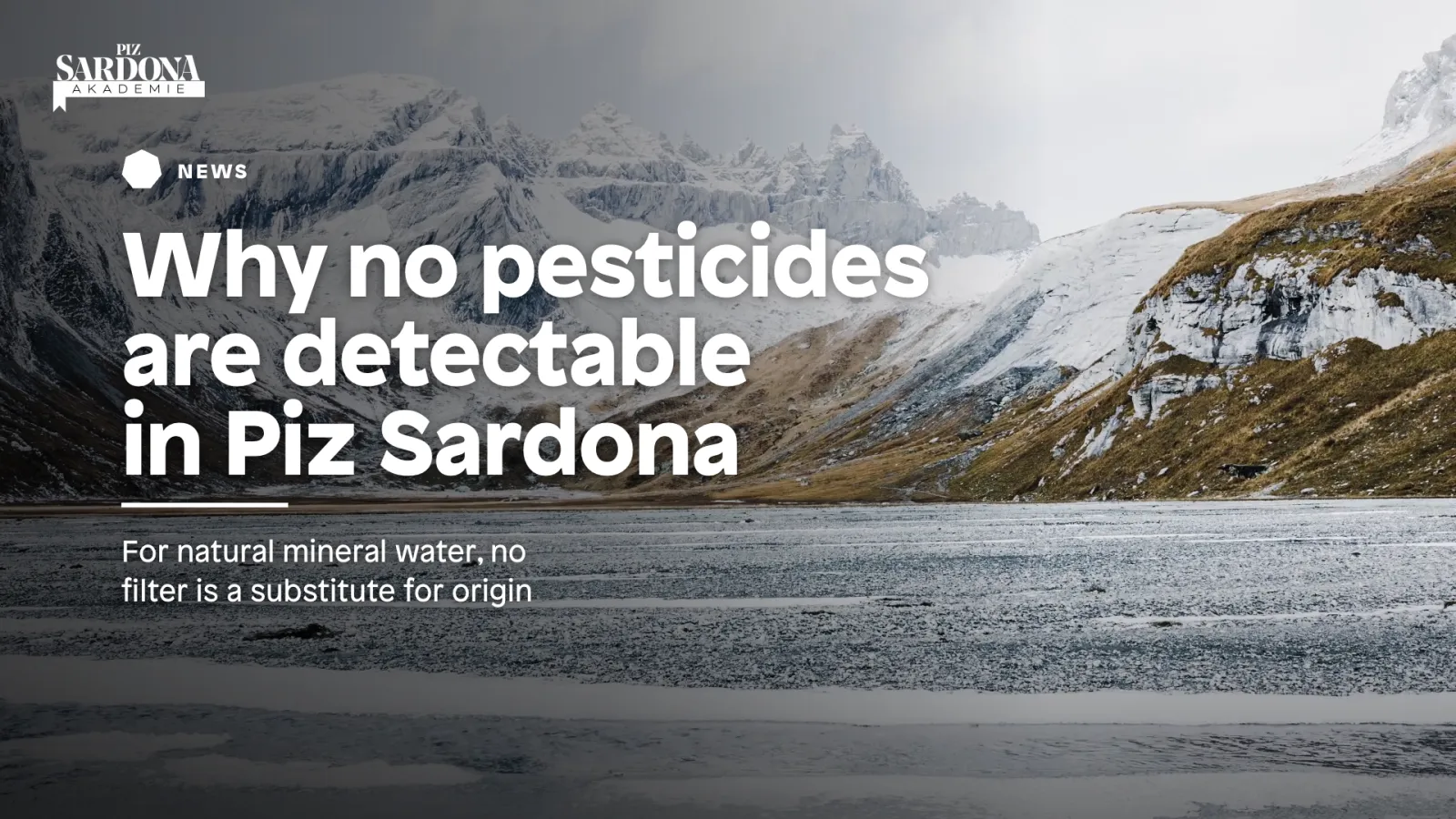
Over the past few months there has been a lot of reporting on pesticide residues in Swiss mineral water springs. We at Mineralquellen Mels AG are writing this article because something fundamental is getting lost in the discussion about ‘clean alternatives’. Whether a mineral water contains pesticides does not depend primarily on how deep the spring lies or how old the water is. It depends on what happens on the soil the rainwater seeps through. Where there are arable fields, vegetable and fruit crops and vineyards, plant protection products are applied; these crops account for the largest share of the quantity used (Agroscope). Where there are none, the most important source of input is absent.
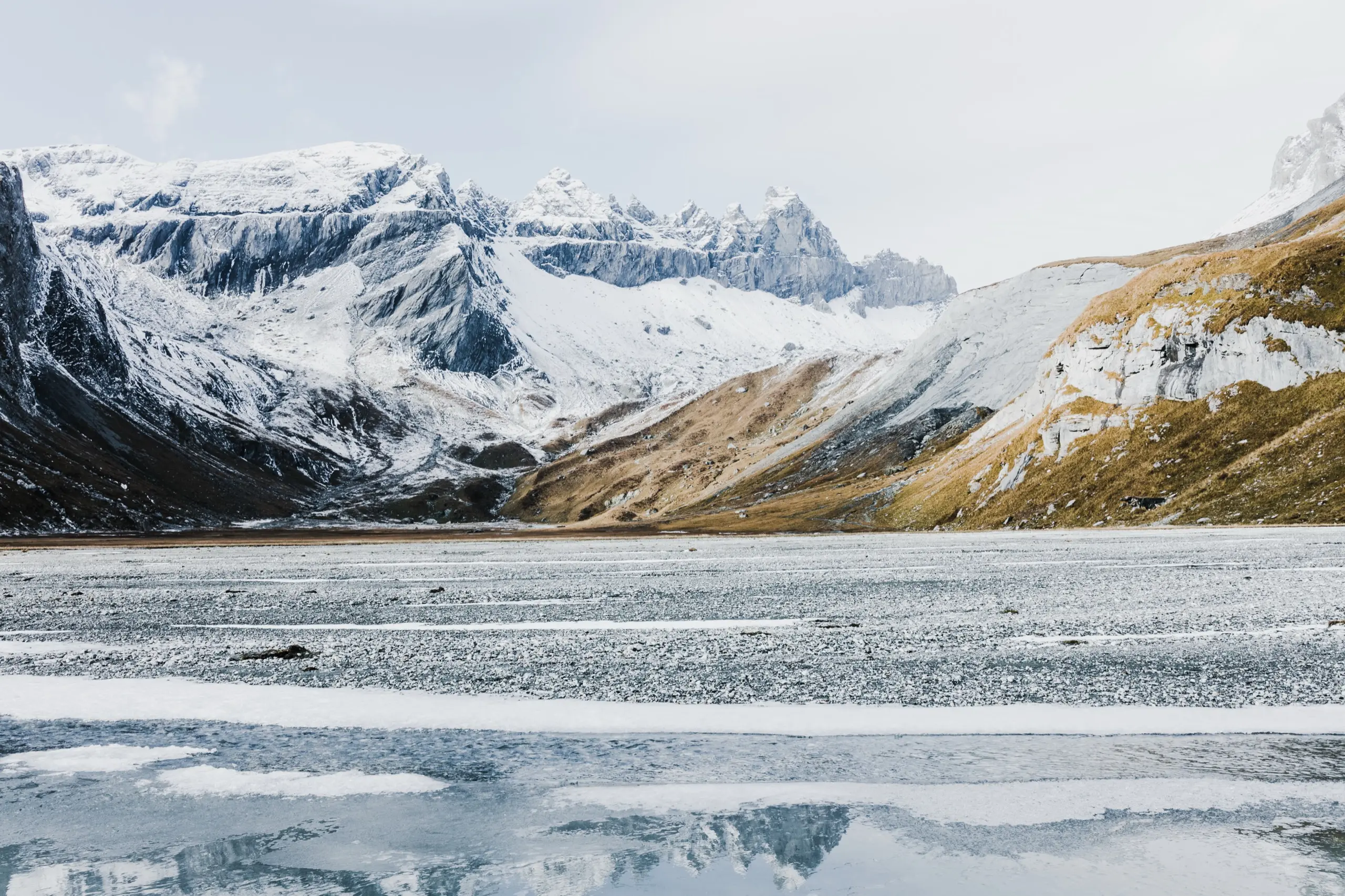
The water of Piz Sardona seeps into the ground in the high Alps above 2,000 m above sea level, by the UNESCO World Heritage Tectonic Arena Sardona. In the infiltration area there are no arable fields, no vegetable or fruit crops and no vineyards. That is the whole difference.
What the debate of recent years shows
The reporting on residues of plant protection products in Swiss water has shaken the industry. Media reports and investigations by cantonal chemists made it clear that springs in intensively used regions, too, are not automatically protected against influences from the surface. Because a natural mineral water may not be freed of residues, springs in such regions come up against natural limits.
Chlorothalonil is a fungicide that was widely used in Switzerland from the 1970s onwards, on cereals, potatoes, vegetables and vines, among other crops. Since 1 January 2020 it may no longer be used (Eawag). Its breakdown products are persistent and continue to seep into groundwater for years. The ban applies in the field immediately; in groundwater, the values are falling only slowly: between 2020 and 2025 the share of monitoring sites with more than 0.1 micrograms per litre fell from around a third to just under a quarter (FOEN).
Chlorothalonil breakdown product R471811 in groundwater
Share of the NAQUA monitoring sites tested that had more than 0.1 µg/l, in per cent
The chart shows groundwater from across the country, not bottled mineral water and not a measurement of Piz Sardona. Each site counts once, with its highest value of the year; R471811 has been measured nationwide since 2020.
Choose a bar
The hydrogeological reality shows that if the catchment area of a spring lies in an intensively used agricultural zone, that use helps determine what arrives in the water. Pollutants that seeped into the soil decades ago migrate slowly through the layers. For spring operators in such regions this is an enormous challenge, because the location of a catchment area cannot be changed after the fact.
Where the pesticides come from: the infiltration area is decisive
Mineral water begins as rain. The rain falls on an area — the catchment or infiltration area — then seeps through soil and rock and re-emerges years later as a spring. On its way down, the water can carry with it what is applied to this area: nitrate from slurry, herbicides from the maize field, fungicides from the vineyard.
What happens above a spring
Catchment with arable farming
- Fields, vegetables, orchards or vineyards
- Plant protection products and fertiliser on the land
- Breakdown products and nitrate can seep into the groundwater with the rain
Infiltration area in the high mountains
- Rock, scree and alpine pastures
- No arable fields, no vegetable or fruit crops, no vineyards
- The water seeps down through layers of rock
What is applied in the catchment area helps determine what can reach the groundwater. Whether residues actually arrive there is ultimately shown by the analysis.
That is why the location of the infiltration area matters more than any figure on the label:
- Swiss Plateau: in Switzerland, arable farming is concentrated at low altitudes; in 2024, 95 per cent of open arable land lay in the valley and hill zones (Agristat). It is also on the Swiss Plateau, which is used intensively for agriculture, that the breakdown products of chlorothalonil are most widespread in groundwater (FOEN). In early 2020 the magazine K-Tipp found breakdown products of chlorothalonil in the tap water of 13 out of 30 households in German-speaking Switzerland (K-Tipp).
- Depth offers only limited protection: a deep tapping or a long journey through the rock delays the problem; it does not eliminate it. What seeps in at the top arrives at the bottom — only later. A water in which nothing is detectable today can contain today’s residues in ten years’ time if there are arable fields, vegetable or fruit crops or vineyards in its catchment area.
- High Alps above the tree line: here there are no arable fields, no vegetable or fruit crops and no vineyards; instead there are alpine pastures, scree and rock. According to Eawag, the water research institute of the ETH Domain, groundwater with a catchment area at higher altitude and without arable farming is probably not contaminated with the breakdown products of chlorothalonil, or only slightly so (Eawag). In an evaluation of the National Groundwater Monitoring, almost no residues of plant protection products were found at monitoring sites in the Alps and Prealps whose surroundings consist of summer pastures and unproductive land (FOEN). This is not a marketing claim; it is hydrogeology.
Where arable farming takes place in Switzerland
Distribution of open arable land in 2024 (275,535 ha) across the agricultural zones, in per cent
Valley and hill zones together: 95 per cent. The zones come from the agricultural production cadastre and reflect how difficult the land is to farm, not altitude alone. Summer grazing areas with their alpine pastures are not part of the utilised agricultural area and are not included in these zones.
Choose a bar
Why we don’t say ‘pesticide-free’
Since the reports on contaminated springs, many people have been wondering whether their mineral water is ‘pesticide-free’. We deliberately say ‘not detectable’. There are three things you should know about this:
- A negative test is a snapshot. It tells you what is in the bottle today. It tells you nothing about what is seeping into the ground in the catchment area and will only arrive years from now. This applies in particular to springs whose catchment area borders on arable land.
- ‘Pesticide-free’ does not mean free of pollutants. In a 2024 test of ten mineral waters by RTS and the SRF programme ‘Kassensturz’, two laboratories found traces of unwanted substances in four products: breakdown products of pesticides in one, microplastics or the PFAS substance PFBA in the others. The laboratory did not classify any of the values as acutely dangerous (SRF). Anyone who tests only for chlorothalonil sees only chlorothalonil.
- The difference between a guide value and original purity: there is no legal maximum level for pesticides in mineral water. As an indicator of purity, the Federal Food Safety and Veterinary Office (FSVO) cites a guide value of 0.1 micrograms per litre for the sum of pesticides. The law, however, requires more: a natural mineral water must be of original purity. Trace substances of human origin, such as pesticides and their breakdown products, must not occur in it at all, nor may they be filtered out (FSVO). That is the obligation of every bottler. For us, this purity begins with the infiltration area.
A laboratory can show that the substances it looked for are below the limit of detection of its method. No analysis can prove that a substance is not present in any amount. That is why we stick to what we can back up: not detectable, according to a laboratory report that states the laboratory, date, scope of testing and limit of detection. These four details make a finding comparable, and they are worth asking for with any mineral water. What ‘not detectable’ means exactly is explained in the article on PFAS in water.
What the limit of detection means
- below the limit of detection: not detectable
- above the limit of detection: detectable
Sensitive method
Below the line, the finding reads ‘not detectable’ — a statement about the measurement, not about the absence of a substance. The limit of detection is never at zero.
Drag the slider or use the arrow keys
In our view, anyone who uses purity in their advertising should show where their water seeps into the ground — and be able to produce the laboratory report to go with it. We do both.
What applies to Piz Sardona
The reason no pesticides are detectable in Piz Sardona is so simple that it sounds almost banal: in the infiltration area there are no arable fields, no vegetable or fruit crops and no vineyards.
Rain and snowmelt seep into the ground in the Sardona Alps above 2,000 m above sea level, by the UNESCO World Heritage Tectonic Arena Sardona, in high-alpine terrain far above the arable farming areas. The water then travels through layers of rock and stone for around twelve years until it is tapped from the Castels spring in Mels. The whole journey is shown on the Origin page.
The journey of the water
Precipitation seeps in
over 2,000 m a.s.l.
Filtered through rock
around 12 years
Castels spring, Mels
pH 8.0
For Piz Sardona, the finding is: not detectable. On request, we will gladly send the full laboratory report, which states the laboratory, date, scope of testing and limit of detection; a message via the contact form is all it takes.
For a natural mineral water, this finding is not a distinction but the requirement for the entire category. What sets Piz Sardona apart is the cause: for a water whose infiltration area has no arable fields, no vegetable or fruit crops and no vineyards, ‘not detectable’ is rooted in where the water comes from.
Added to this is what distinguishes Piz Sardona in any case: a naturally alkaline pH of 8.0 and a balanced mineralisation from the Alpine rock. Like every natural mineral water, it is bottled directly at the spring, in Mels, in the canton of St. Gallen. More on this in Piz Sardona: the mountain behind the water.
What we do not promise
The high mountains are not untouched either. Livestock graze on alpine pastures in summer, and targeted treatments against individual problem plants are permitted there (Direct Payments Ordinance). Every analysis is also a snapshot. We therefore do not promise that nothing will ever be found. We promise to keep having the water tested and to send the latest laboratory report on request.
Conclusion: don’t ask about the filter. Ask about the field.
Quality begins at the origin. The discussions of recent years show that the location of the catchment area is the decisive factor in how pure a water remains in the long term. No filter technology can change the origin of a water after the fact, and filtering out residues is not permitted for a natural mineral water in any case. Anyone looking for a natural product that is as untouched as possible in the long term must therefore look away from the shelves and towards the origin of the springs.
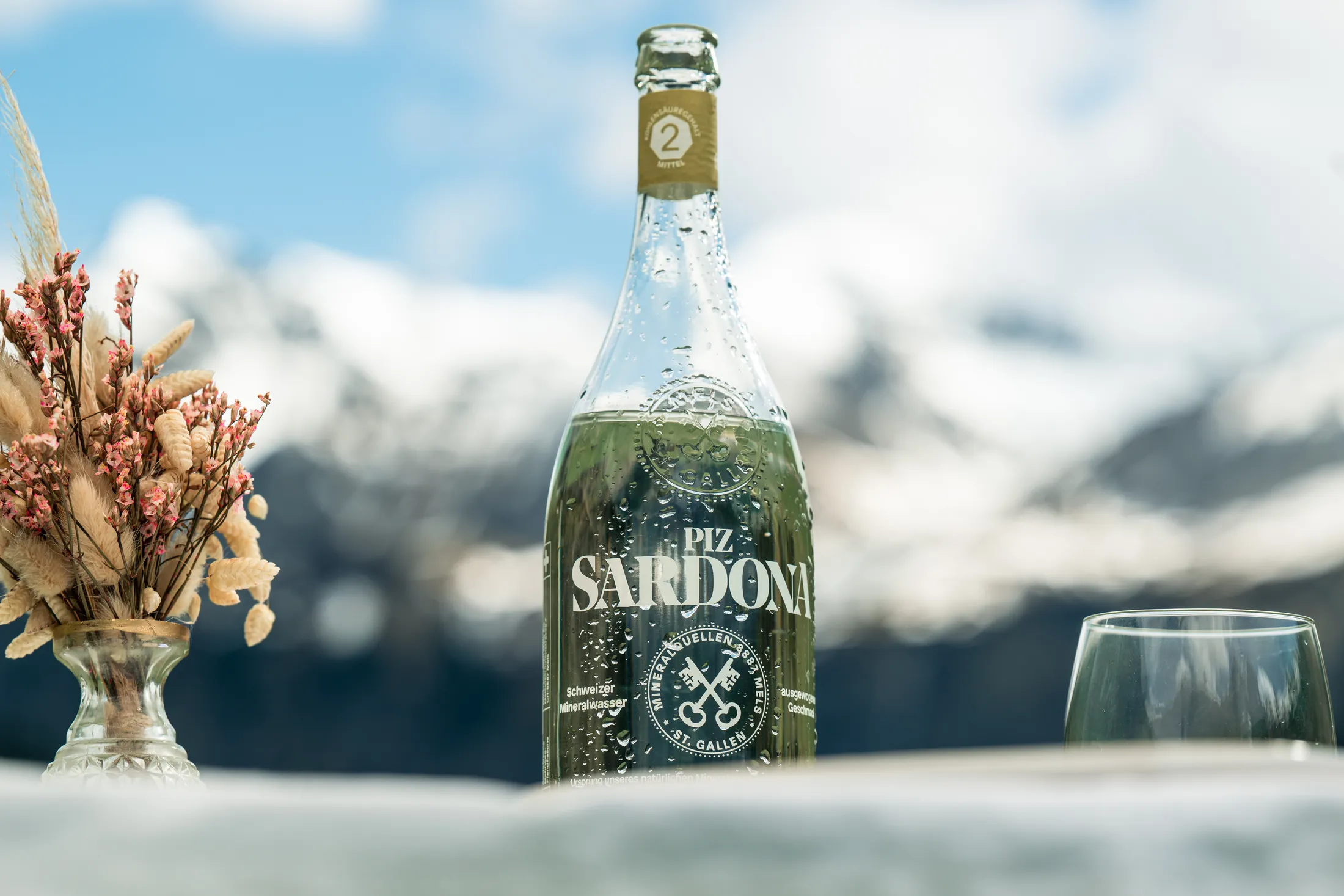
If you are switching to a different mineral water, ask just one question: where does this water seep into the ground? If the answer is ‘in the high Alps, above 2,000 metres, without arable fields, vegetable or fruit crops and without vineyards’, the origin speaks for itself. Even so, with Piz Sardona you also get the laboratory report on request.
Was this article helpful?
Frequently asked questions
Is Piz Sardona pesticide-free?
No pesticides are detectable in Piz Sardona water. We deliberately say ‘not detectable’ and not ‘pesticide-free’: an analysis can show that the substances looked for are below the limit of detection, but not that they are not present in any amount. We will send the laboratory report on request.
Why are no pesticides detectable in Piz Sardona?
Because of its origin. The water seeps into the ground in the Sardona Alps above 2,000 m above sea level, in an area without arable fields, vegetable or fruit crops and without vineyards, and then travels through the rock for around twelve years until it is tapped from the Castels spring in Mels. Residues of plant protection products are found mainly in groundwater from arable farming areas. Trace substances of human origin, such as pesticides, must not occur in a natural mineral water in any case; what Piz Sardona brings to this is its origin.
Can the laboratory report be requested?
Yes. We will gladly send the full report on request; a message via the contact form is all it takes. It states the laboratory, date, scope of testing and limit of detection.
Ask the Academy
Still have a question? Ask us. We will answer it and publish it here below the article. Medical questions about individual cases, however, belong with a doctor.
Poll
How do you like your water best?
Read next
Pesticides in mineral water: why the catchment area is decisive
How do pesticides get into mineral water? What tests have found, why the catchment area of a spring is decisive and what applies to Piz Sardona.
ReadCan mineral water be filtered? What is permitted — and what is not
Activated carbon, UV light, chlorine: what is allowed for tap water is prohibited for natural mineral water. Which processes the law permits, and why.
ReadPesticides in drinking water: what chlorothalonil means for Switzerland
Chlorothalonil and other pesticides in Swiss groundwater: where the values are exceeded, what water utilities are doing and what it means for mineral water.
ReadPiz Sardona
Alkaline mineral water with a pH of 8.0 from the Castels spring in Mels — filtered through the rock of the Sardona Alps for twelve years.
Our water